Spektx · intellectual property · SPEKTX LLC

The display family.
Filed, built, checked.

Spektx is the display technology SPEKTX LLC was founded on: a patent-pending family covering transparent display nodes inside glass, one picture across screens that do not touch, projection across curved surfaces, passive aerial display surfaces lit from the ground, and billboard and freight-trailer display systems.

Two foundation filings form the trunk. Five additional members stand independently. Where a computational core has been implemented, it is reduced to working software that runs without a network and is checked against defined tests or demonstrations.

This page is Spektx alone. Chorix, Chorix Ensemble, Social Command, the Judgment Layer, EUTONIX Service OS, EUTONIX FD, Prevtx, Ignotix, Chorix Kymtx, UGENYX and Krytix belong to separate SPEKTX product and intellectual-property portfolios. They are not part of the Spektx display family and are not described here.

  • Active nodes 11 / 11
  • Dead-zone pixels assigned 0
  • Inter-node gap cancelled, not stretched
  • One master asset sliced per node
  • Sync tolerance < 1 frame
  • Node lost reclassify · re-slice · resume
  • Coherence predictive · payload on divergence only
  • 7members of the family
  • 9engines that run and check themselves
  • 6demonstrators you can drive
The Spektx Display Engine, the theater machine as it exists, in Mosaic, seen from above: the hub at the centre, three seats on the ring, the manager hanging off the hub toward the viewer with its hands in a hexagon around it; every surface carries its own slice of the SPEKTX mandala at the same strength, the SPEKTX X with its prism, drawn by a thin dark outline with the mandala carrying on through it, sits centred on the hub with its corners at the hub's rim, and the space between the surfaces is dark

Two foundations. Three branches. Two independent tracks.The tree is conceptual, not a chain of priority. Each branch rests on its own filing and distinct inventive subject matter, so any one of them can be owned or licensed apart from the rest. The foundation is available for licensing by field of use.

Foundation · 01

Emissionthe display node

Patent pending · shown in a demonstrator

A thin, transparent display node that mounts to the inside of existing glass without adhesive, and sends its light only outward and downward, into the cone a passer-by sees. From inside, the glass stays clear and dark. The node is a physical thing; the engines on this page draw its cone, they do not build it.

In software: the Mosaic + Emission demonstrator draws each node's downward cone and keeps the interior face dark.

Foundation · 02

Mosaicthe network and its method, with predictive coherence

Patent pending · engine complete

One master picture is cut into fragments for separate screens that do not touch: glass, storefronts, the windshields on a lot. The gaps and the structure between them are classed as dead zones and receive no pixels, so the picture is cancelled across the gap rather than stretched over it. Every screen runs on a clock held within one frame of the others; when a node is moved, lost or added, the picture re-slices. With predictive coherence each node predicts its own state and is sent a payload only when it diverges, so a node that loses contact carries on by itself. A runtime ledger measures each node's contribution and shares the revenue by what was actually shown.

Predictive coherence, a little closer. Every node runs the same deterministic model of the programme and advances it by itself between sparse reconciliation updates. When an update arrives, the node measures how far its own prediction was off, corrects by a fixed gain, and takes the size of that error as its margin: a small error lets it run longer alone, a large one shortens the interval, and a model that does not match falls back to plain synchronisation. The nodes keep relaxed local time references rather than a precision clock distributed to them continuously, and where a node sits never enters the content state: moving a node changes the geometry only.

In software: dead-space cancellation and predictive coherence; the advertising ledger and impression model; the Spektx Display Engine, the dead-space demonstrator and the Mosaic + Emission demonstrator.

Branch · 03

Billboardthe ground-fixed display

Patent pending · engine complete

A permanent, ground-fixed digital billboard built from transparent display panels. The frame carries less wind than a solid sign of the same size. A battery buffer sources the peaks, so the grid sees a steady draw. A master-and-slave cascade keeps every panel within a frame of the others, with a satellite link as the fallback when the ground link fails. A stored calibration map for every panel means a picture is cut into its pieces the same way every time and lines up across the joins. Each host sees their own node's runtime and share on a read-only dashboard, and nothing else.

In software: the billboard cascade and calibration map. Patent pending in the United States, with an Australian consolidation.

Branch · 04

Trailerthe vehicular canvas

Patent pending · engine complete

A display skin for a freight trailer that cannot touch the trailer's brakes. Polycarbonate panels clamp to the trailer's own rails with no hole in the skin and a ventilation gap behind them. Power comes from the standard seven-pin harness through an isolation stage, so the brake line stays a sense-only line and the display's load can never pull it down. The seams float, so the panels can grow from a winter night to a summer afternoon without buckling. A marker array along each panel lets a camera pipeline keep the picture registered to within a fraction of a pixel while the trailer flexes on the road.

In software: the trailer registration pipeline. Patent pending in the United States, with an Australian consolidation.

Branch · 05

Data bankthe intelligence engine

Patent pending · specification only

A geospatial engine that classifies commercial property by the quality of its anchor tenant and its occupancy, so that advertising on a surface can be priced by what surrounds it, and a market can be read as a map. It grew up inside the billboard filing and is carved to stand on its own. The datasets and model weights behind it are held as trade secrets and are not part of any filing.

In software: none yet. This is the one member of the family with no engine built.

Track · 06

Projectionimmersion on curved surfaces

Patent pending · engines complete

Projection onto a dome, a cylinder or an irregular wall from a scan of the surface itself, in place of weeks of hand calibration. For every projector the engine works out how far each ray travels and how much to pre-distort the picture so it lands straight; declares a void where there is nothing to hit; redistributes the picture around the void in exact proportion; and blends the overlap where two projectors meet. The same math exists twice, as a reference engine and live in a browser, written to one contract.

In software: the warp and void driver; the warp pipeline; the predistortion engine for the browser.

Track · 07

Aerialthe passive swarm

Patent pending · engine complete

Aerial surfaces that carry no lights of their own. A projector on the ground lights them. The engine finds each surface from the infrared returns of its markers, predicts where it will be at the instant the light arrives, corrects the picture for its angle and its range, deletes the air between the surfaces so nothing is projected into empty sky, and blanks the beam the moment something untracked crosses it. The same show runs indoors or out, from a station that stands still or one that moves.

In software: the aerial mapping engine; the Aerial night lake demonstrator. Patent pending in the United States, with an Australian consolidation.

Standing words mean what they say. Engine complete means the software implementation runs end to end and passes the verification defined for that engine. Shown in a demonstrator means software reproduces or visualizes the claimed physical behavior; it does not mean the physical hardware has been constructed. Specification only means no corresponding software engine has yet been built. Every engine here is a software core: the glass, the projectors, the scanners, the airframes and the steel are hardware, and are not built.

Nine engines, each with its own check.Eight complete, one mostly complete. Every engine identified as complete here ran and passed its defined check on October 8, 2026 on SPEKTX's development system. The advertising ledger, which has no independent automated check, reconciled exactly in a manual run the same day. None requires a network connection.

EngineMemberWhat it provesStanding
Dead-space cancellation and predictive coherenceMosaicOne picture across screens that do not touch, the gaps cancelled rather than stretched over; a cold start; a node that loses contact carries on from its own prediction and reconciles when it returns; a node that goes absent; shape and picture kept apart.Complete
Advertising ledger and impression modelMosaicImpressions from a traffic model that follows the venue and the hour, driving the ledger live; the accounts that share the revenue reconcile exactly.Complete
Billboard cascade and calibration mapBillboardA stored map for every panel; the picture cut the same way every time, byte for byte; registration across a physical gap between panels; a master-to-slave cascade with fragments latched verbatim; sync held within a frame, with satellite failover; tamper detection on every fragment.Complete
Trailer registration pipelineTrailerThe six stages the specification recites, in order: adaptive threshold, sub-pixel contours, pose from the markers, a homography per panel, an inverse counter-warp, a blanked seam; its residual sits inside the specification's own tolerance.Complete
Warp and void driverProjectionHow far each ray travels, how much to pre-distort it, what to do where there is nothing to hit, how neighbouring projectors blend; its own check and a full unit suite.Complete
Warp pipelineProjectionThe deployment form: a scanned dome, every projector solved over it, the void volumes applied, and the meshes a venue would load written out. Runs end to end; it has no check of its own yet.Mostly complete
Predistortion engine for the browserProjectionThe same math live in a browser: from a synthetic scan, a lens model and void volumes to solved meshes and the corrected feed drawn for each projector.Complete
Aerial mapping engineAerialPose from infrared returns, untracked below three; prediction at the projection instant; brightness corrected for range; the air between surfaces deleted; the beam blanked on an untracked intrusion; a station that stands still or moves.Complete
Color manipulatorShared · the creativeTone, colour, selective hue, curves, presence and lookup tables for the picture that goes on the surfaces; serves its own grading page. Not tied to one filing.Complete

The security core behind Krytix and the two governance engines behind Chorix were built the same way and are listed with these nine on the engines page. They belong to separate portfolios and are not part of the Spektx display family.

Six scenes built on the engines.One complete, two mostly complete, three under construction. Each is a page you open and drive.

The figure is the Spektx Display Engine, the simulator built in July 2026 to reduce the mosaic filing to practice. One master picture is loaded once, by dropping it on the page or through the Add control. Every surface of the machine, the hub, the three seats, the manager and its six hands, the ring and the spokes, is a separate display that draws its own slice of that one picture, sampled at the surface's own position in the viewer's frame, so the picture reads whole from where you stand. The dark space between the surfaces is assigned no pixels: it is cancelled, not stretched over. Spin the machine and every slice re-registers as the surfaces move; Reflect does the same with a live camera, the room mirrored across the chrome. The ledger beside it counts what was shown. Every surface carries its slice at one strength, because it is one picture. This embodiment is Spektx's own, a demonstration of the mosaic member of the display family. It is not part of Chorix, Chorix Ensemble or Chorix Kymtx.

The Spektx Display Engine in Mosaic mode with its controls above: the theater machine from above, the hub, three seats, the manager and its hexagon of hands, every surface carrying its own slice of the SPEKTX mandala at the same strength, the SPEKTX X and its prism centred on the hub as a thin dark outline, the mandala carrying on through it, the space between the surfaces dark
Spektx Display Engine · Mosaic: the SPEKTX mandala as one creative across the whole machine, with the SPEKTX X and its prism over its centre, drawn as an outline of dead space: a thin line given no light, the mandala carrying on through it. The hub, the three seats, the manager and its hands, the ring and the spokes each carry their own slice at the same strength; the dead space is cancelled. The full machine, at rest, from above, with its controls; Pro Color contrast at 2.00.
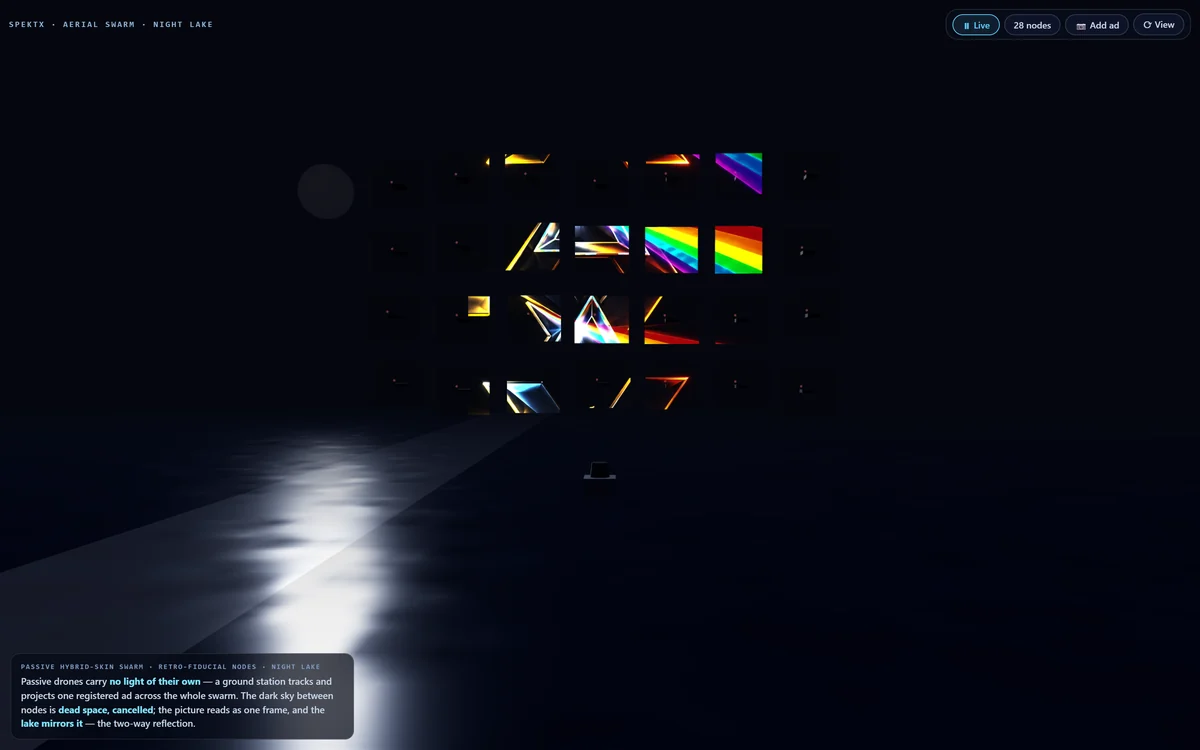
Aerial night lake: the whole swarm of twenty-eight passive nodes over water at night, carrying the SPEKTX prism X as one picture, the sky between the nodes dark, the ground station on the shore below
Aerial night lake · the SPEKTX X projected across the whole swarm from the ground, the sky between the nodes cancelled. The full swarm, drift stopped.
DemonstratorMemberWhat it showsStanding
Spektx Display EngineMosaicA three-dimensional array of separate screens you can drive: one creative across all of them, a live camera, mirror and projection modes, a colour grade, creative libraries, and the advertising ledger running live.Mostly complete
Dead-space demonstratorMosaicA single offline page: drag a picture across separated screens and watch the gaps cancel.Complete
Dealership Facade Command · the Mosaic + Emission demonstratorEmission · MosaicCars on a lot as one canvas: the windshields are the nodes, the bodywork and the gaps between cars are dead zones that receive no pixels. Drag a pane and the picture re-slices live; drop a node and the ledger re-weights. Each node's light is confined to its downward cone. Facade, storefront, trailer and billboard scenes beside it.Mostly complete
Aerial night lakeAerialA passive swarm over a lake at night shows one picture; the sky between the nodes is cancelled and the lake mirrors it.Under construction
Dealership lotMosaicOne image across the windshields of a row of cars, the gaps between them cancelled.Under construction
ViewerSharedA stand-alone viewer for the display scenes.Under construction

Five lines that govern the portfolio.They decide what can be licensed, what stays, and what is never handed over.

Each branch stands alone

The billboard, the trailer, the data bank, projection and the aerial swarm each rest on their own filing and distinct inventive subject matter. Any one can be owned or licensed apart from the others, and taking one conveys no right in another.

The foundation is available for licensing by field of use

The display node and Mosaic network form the foundation. They may be licensed by field of use, allowing a branch to stand independently or incorporate the foundation where appropriate.

Data stays with the inventor

Datasets, model weights, calibration data and proprietary parameters used by the engines are retained as trade secrets unless expressly licensed. They are not conveyed merely by licensing or acquiring rights under a patent.

The software is a separate asset

The engines and demonstrators are separately owned copyright works of SPEKTX LLC. Patent rights do not by themselves convey source code, software implementations, datasets, model weights or other implementation assets. Any such rights must be separately and expressly licensed.

Patent pending

The technology on this page is the subject of pending applications in the United States, with Australian consolidations of the billboard, trailer and aerial branches. Kevin Bramble, the company's founder, is the inventor.

The rest of the house.The company's other work carries its own intellectual property.

Spektx is where SPEKTX LLC began, but it is one portfolio within a larger body of work. Krytix, Chorix and the company's software products each have separate technology, code and intellectual-property positions. None forms part of the Spektx display family. Their current status is shown on the SPEKTX family page.

Where predictive coherence went next. Its idea, local prediction between sparse authoritative corrections with a measured margin deciding when to fall back, was carried from pictures to decisions in two governance filings. Both are patent pending. They belong to the Chorix governance portfolio, not to the Spektx display family, and are named here only for that lineage.

Escalation chains (per-gate human authority). Each gate in a supervised multi-model workflow is bound to its own chain of approvers. If the first does not answer in time, the next in the chain is notified as well, and the earlier approver can still answer. Exactly one resolution wins. Each notice carries a fresh single-use code over the approver's own channel; a verb outside an approver's scope is refused at the server, not merely hidden on the screen; and every resolution, and every attempt it superseded, is attributed.

The judgment specification (margin-governed autonomous action). From a signed record of one named person's own rulings on what an agent proposed (approve, reject, steer, redirect, stop), a fidelity score is measured for each kind of action and scope by walking forward through the record, predicting each past ruling only from the ones before it. The software acts alone only where that score meets a declared bound and enough rulings stand behind it; otherwise it escalates to the person, whose answer joins the record. The party that enforces the decision holds neither the person's key nor any part of the record.

Each has a reference engine that needs no network connection and passed its built-in checks on October 9, 2026 on SPEKTX's development system: thirteen of thirteen for escalation chains, and eight of eight for the judgment governor, which also reproduces the specification's own worked example. These are self-tests on one system, not third-party certification, and the escalation-chain engine models parts of its claim set ahead of the product.